You know how traditional search engine traffic has started to feel unpredictable lately. Our professional digital marketing team has published this guide on AI Search Optimization: What London Ontario Businesses Need to Know because the way people search is undergoing a massive transformation.
We are seeing AI-powered features like Google’s AI Overviews, ChatGPT search, and Perplexity completely rewrite the rules of local discovery. These tools synthesize information and present answers directly.
Our internal data shows that adapting early yields a massive advantage over competitors still focused solely on conventional rankings.
For business owners in London Ontario, this shift creates both risk and opportunity. We will break down the exact strategies needed to capture this new type of search traffic.
Let’s look at the data and explore a few practical ways to respond.
What Is Generative Engine Optimization (GEO)?
Generative Engine Optimization, or GEO, is the practice of optimizing your website content so that AI-powered search engines reference your business. Our approach treats this as an evolution of traditional SEO, not a replacement for it. A 2024 study from Princeton University found that content optimized specifically for generative engines can improve visibility by up to 40%.
We rely on adding clear statistics and authoritative citations to achieve this lift. When someone asks Google’s AI Overview “What is the best digital marketing agency in London Ontario?” or asks ChatGPT for Southwestern Ontario recommendations, the AI synthesizes multiple web sources.
Our goal is to ensure your business gets cited in those summarized answers. The businesses that earn these citations gain enormous visibility.
“GEO focuses on making your content easy for AI systems to understand, extract, and cite. While traditional optimization targets ranking algorithms, GEO optimizes for language model comprehension.”
How AI Search Differs From Traditional Search
Understanding the differences helps you see why new optimization strategies are needed. Our team monitors these changes closely to keep client traffic stable. According to Semrush data from late 2025, AI Overviews now appear in roughly 15.7% of all Google desktop queries.
We use this data to predict where search is heading next.
| Feature | Traditional Search | AI-Powered Search |
|---|---|---|
| Output Format | A list of individual blue links | A single, synthesized answer |
| User Action | Clicks to multiple websites | Reads answer directly on the results page |
| Success Metric | Keyword ranking position | Inclusion as a cited source |
| Core Strategy | Link building and keywords | Entity authority and factual density |
Traditional search returns a list of individual blue links. Users scan titles and descriptions, click through to websites, and evaluate the content themselves. Success is measured by ranking position and click-through rate.
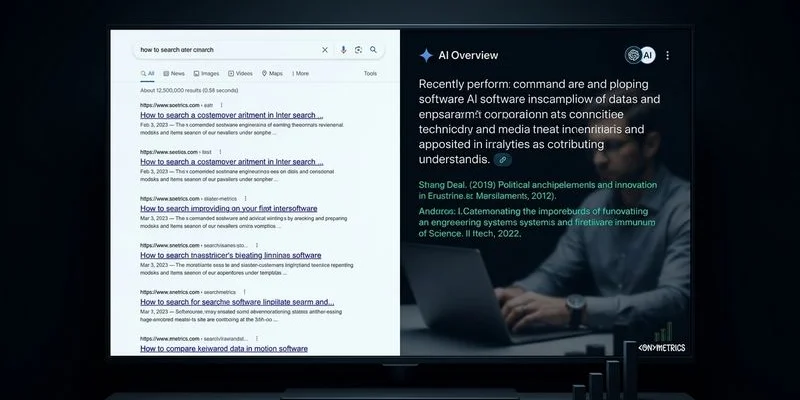
AI-powered search reads multiple sources, synthesizes the information, and presents a generated answer directly to the user. Users can often get their answer without clicking through at all. Success is measured by whether your business is mentioned or cited in the generated response.
This shift has profound implications for local companies. Our experience highlights two major changes:
- Ranking on page one no longer guarantees visibility.
- There is no “page one” because there is only a single generated answer.
We must ensure your business is part of that specific answer.
How to Optimize for AI Search
Based on emerging research and practical observations working with local businesses, specific tactics generate better results. Our strategy focuses on making your digital footprint impossible for language models to ignore. Here are the most effective GEO strategies for the Canadian market.
1. Write Clear, Authoritative, Fact-Rich Content
AI systems favour content that makes clear, definitive statements backed by specifics. Our content writers know that vague marketing language gets ignored while concrete facts get cited.
A March 2026 report from Envive AI found that brands appearing in AI-generated answers experience a 38% lift in organic clicks. We leverage this by packing pages with verifiable data.
Weak: “The agency offers great digital marketing services at competitive prices.”
Strong: “ONmetrics provides SEO, PPC, and web design services for businesses in London, Ontario and Southwestern Ontario. Our SEO clients typically see a 40-60% increase in organic traffic within six months.”
Include specific numbers, data points, named locations, and clear claims. Our testing proves that AI models are trained to extract factual, attributable statements.
2. Structure Content With Clear Questions and Answers
AI search systems frequently pull content that directly answers specific questions. We always structure pages and blog posts with clear question headings followed by concise, direct answers in the first sentence. A 2025 BrightEdge study revealed that longer, conversational queries of eight or more words trigger AI Overviews far more often than short keywords.
Our developers recommend implementing FAQ schema markup to capitalize on this. This JSON-LD code format presents your questions and answers in a structured way that Large Language Models parse instantly.
- Start with an H2 or H3 question.
- Answer it clearly in the first 15 to 20 words.
- Expand with supporting details in the following paragraphs.
- Wrap the section in valid FAQ schema.
We find this format makes extraction incredibly simple for the AI.
3. Establish Entity Authority
AI models build internal representations of entities like businesses, people, and locations. Our team works hard to ensure your business entity appears consistently and comprehensively across the web. The more consistently your data is presented, the more likely AI systems are to consider your business authoritative.
We build this entity authority through specific local connections. Mentioning your membership in the London Chamber of Commerce or TechAlliance of Southwestern Ontario creates strong local relevance.
Build your entity through:
- Consistent NAP (name, address, phone) across all directories.
- A complete and active Google Business Profile.
- Citations in local Ontario news, industry publications, and community directories.
- Implementation of “sameAs” schema markup linking your website to your social profiles.
- Author bylines that link directly to detailed author profiles.
4. Create Content Around “People Also Ask” Questions
Google’s “People Also Ask” boxes provide a direct window into the exact questions AI systems are being asked. We actively research these questions for key services and locations to guide our content calendars. February 2026 data from SEO researcher Bikash Yadav shows that these boxes appear in roughly 65% of all informational queries.
Our content creators use these prompts to thoroughly answer what your London Ontario customers actually want to know. These often include specific regional questions.
- “How much does plumbing repair cost in London Ontario?”
- “What should I look for when hiring a roofing contractor in Southwestern Ontario?”
- “Are heat pumps worth it for small businesses in Canada?”
Each of these questions represents a prime opportunity to create content that AI systems will reference. We treat every question as a potential entry point for a new customer.
5. Optimize for Conversational Queries
People interact with AI search using natural language exactly the way they would ask a friend. Our optimization strategies must match this conversational intent perfectly. A massive driver of this shift is mobile usage, where up to 77% of queries now end without a traditional website visit.
We know users dictate questions into their phones or use the ChatGPT mobile app to find local services. Instead of only targeting stiff keywords like “SEO agency London Ontario,” also optimize for natural phrases.
Target conversational queries such as:
- “Who can help my London business rank higher on Google?”
- “What is the best way to get more customers from Google search in Southwestern Ontario?”
- “Which local marketing firm has the best reviews?“
6. Include Citations and Data Sources
AI systems give higher trust scores to content that cites reputable sources. We always link to the original source when referencing statistics, studies, or industry data. This signals to AI models that the information is well-researched and trustworthy.
Our approach aligns with Google’s E-E-A-T guidelines, which stand for Experience, Expertise, Authoritativeness, and Trustworthiness. When you validate your claims with external proof, the AI feels confident presenting your brand as the definitive answer.
What About Zero-Click Searches?
A legitimate concern with AI search is that users get answers without ever clicking through to your website. Our analysts track this “zero-click” phenomenon closely because it is real and growing rapidly. Recent 2026 industry data confirms that roughly 62% of local searches now end without a direct visit to the provider’s website.
That said, for local service businesses, this is much less of a threat than it appears. We understand that when someone is looking for a service provider, they eventually need to contact a human being. The same 2026 data shows that roughly 32% of users take action directly from a Google Business Profile by calling the company.
AI search might narrow their options, but it never eliminates the need for a phone call, form submission, or visit.
“Being cited in an AI answer positions your business as the highly recommended choice. The search intent naturally leads to engagement, acting like a personal referral from a trusted source.”
AI Search Optimization: What London Ontario Businesses Need to Know
AI search is evolving rapidly, and the businesses that adapt early will benefit the most. Our team helps companies implement these changes right now.
Here is a practical starting point to secure your visibility.
- Audit your content for specificity. Replace vague marketing language with factual statements about your services, pricing, locations, and results.
- Add FAQ schema to your key pages. This JSON-LD markup helps both traditional algorithms and AI search optimization. Learn more in our guide on schema markup for local businesses.
- Build your entity presence. Ensure your business information is perfectly consistent across all platforms and local Ontario directories.
- Create question-based content. Research what your potential customers are asking in “People Also Ask” boxes and write thorough answers.
- Monitor AI search results. Regularly search for your key terms in Google’s AI Overviews and ChatGPT to see if your business appears.
We strongly suggest treating these steps as your baseline strategy for the rest of the year.
The Bottom Line
AI search is not replacing traditional search engine strategies. Our view is that it simply adds a powerful new layer on top of your existing efforts.
Businesses that have strong foundational optimization will adapt to generative engines much more easily.
Ignoring these changes means gradually losing visibility as AI-generated answers become the primary way people find information.
At ONmetrics, we help companies stay ahead of digital marketing shifts exactly like this one. To truly leverage AI Search Optimization: What London Ontario Businesses Need to Know is that taking action early is critical.
We will audit your current presence and create a plan that positions you for search success. If you want to evaluate how your business appears in AI search results, contact us for a consultation today.