Our team sees the exact same scenario play out every week with local businesses.
Google Analytics 4 sits installed on virtually every website, collecting a massive amount of free data. This baseline tracking helps you understand basic traffic flow.
That setup feels complete.
Yet, most founders soon realize that tracking website clicks does not automatically translate into smarter budget decisions. Business owners constantly ask us about Google Analytics 4 vs Attribution Software: Which Do You Actually Need?
We are going to look at the hard data behind GA4’s actual capabilities. Let’s identify its major limitations and explain exactly when dedicated attribution software becomes a necessary investment.
Where Google Analytics 4 Excels
Event Tracking and Audience Insights
We always recommend setting up GA4 because it provides an incredible foundation for understanding your website traffic. The platform shifted away from the old Universal Analytics session model to a highly detailed event-based system.
Every single page view, scroll, click, and form submission registers as an individual event. This granularity gives you a clear picture of user behaviour.
The system also provides excellent demographic insights.
- Age ranges and geographic distribution
- Device usage and browser preferences
- Affinity categories for targeted marketing
Businesses targeting specific markets like London, Ontario or Southwestern Ontario use this data constantly. It helps them confirm their message reaches the right local audience.
Advanced Capabilities and Hidden Limits
Our analysts frequently utilize the exploration reports to build custom funnel visualizations. These specific reports highlight hidden user drop-off points that standard dashboards miss entirely.
The native integration with Google Ads also allows you to import conversion data and optimize your bidding seamlessly. GA4 even uses machine learning to generate predictive metrics, calculating purchase probability and expected revenue for specific user segments.
You should understand that these predictions require a massive amount of data to activate. Based on Google’s 2026 documentation, your property needs to meet very strict thresholds.
- 1,000 returning users who triggered a purchase condition.
- 1,000 returning users who did not trigger that condition.
- Both metrics must occur within a strict 28-day window.
Most local small businesses never hit this volume. Therefore, you cannot rely on this feature for everyday decision making.
Finally, the enterprise-grade infrastructure costs absolutely nothing. This makes it a mandatory installation for every website.
Where GA4 Falls Short
Attribution Bias and Cross-Device Gaps
Our audits consistently reveal that GA4 presents a distorted picture of channel performance. The standard reporting dashboards heavily favour last-click attribution by default.
Channels that introduce new customers at the top of the funnel get systematically ignored. Cross-device tracking also suffers from massive, fundamental gaps.
Google attempts to connect user journeys using Google Signals. This feature fails completely if the user browses without logging into a Google account.
Pro Tip: You lose total visibility the moment a customer researches a home renovation service on their phone and later converts on a desktop computer.
The Privacy and Integration Problem
We see companies losing massive amounts of data due to modern privacy features. A 2026 industry analysis shows that roughly 39% of Canadian internet users now run ad blockers like uBlock Origin.
This technology, combined with browser features like Safari’s Intelligent Tracking Prevention, blocks standard analytics scripts. It renders GA4 blind to a huge portion of your actual website traffic.
The platform also struggles to connect website behaviour to actual revenue. You cannot easily sync GA4 with popular CRMs like Salesforce or HubSpot without building complex middleware.
- GA4 tracks the initial lead form submission perfectly.
- It cannot record if that lead signs a $15,000 contract weeks later.
- It fails to map final revenue back to the original Google Ad.
Without this direct revenue mapping, you are flying blind on your actual Return on Ad Spend. GA4 also enforces strict data retention limits.
The free version automatically deletes user-level data after 14 months. This aggressively limits your ability to run accurate year-over-year comparisons.
What Dedicated Attribution Software Adds
Complete Journey Tracking
Our focus shifted to purpose-built platforms to solve these exact blind spots. At ONmetrics, we developed ONclix specifically to connect marketing touchpoints to actual revenue outcomes.
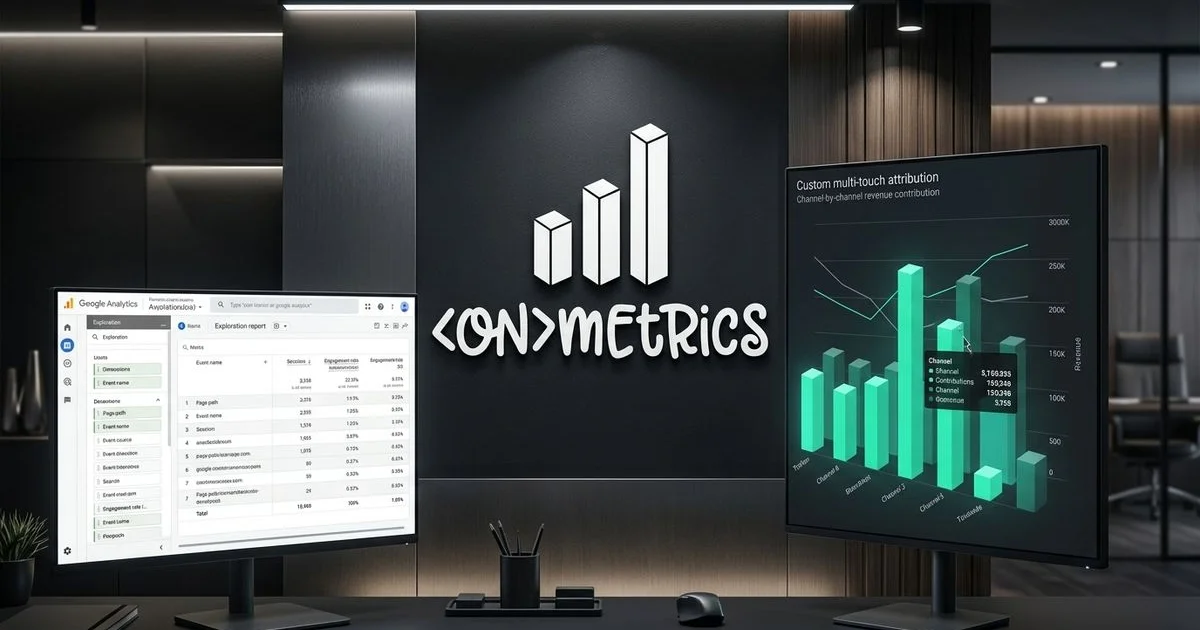
Attribution software uses a multi-touch model by default. It captures every interaction across the entire customer journey.
Every organic search visit, social media click, and direct visit receives the appropriate credit based on its actual impact.
The system then maps these marketing touchpoints directly to closed sales in your CRM. When a lead enters your pipeline and signs a contract, the magic happens.
The exact revenue is attributed back to the specific campaign that originated the sale. This is the single most important capability that basic analytics tools lack.
Technical Resilience and Offline Integration
We rely on first-party data architecture to bypass modern privacy restrictions. Because dedicated platforms use server-side tracking, they capture the critical data that ad blockers hide from standard analytics tools.
Data retention also improves dramatically. While Google deletes user data after 14 months, specialized platforms store your historical data indefinitely.
This software also solves the offline conversion problem for local service businesses in London, Ontario, and across Southwestern Ontario.
- The system assigns unique tracking numbers to different advertising campaigns.
- It links a closed phone sale directly to the original search keyword.
- It stitches together data from Meta Ads, LinkedIn Ads, and organic traffic.
You finally get one unified view. This dashboard reveals your true Cost Per Acquisition across every single platform.
Google Analytics 4 vs Attribution Software: Which Do You Actually Need?
Our clients frequently ask if they should delete Google Analytics entirely. The answer is absolutely no, as both systems serve completely different operational purposes.
Think of GA4 as your microscope. It reveals the highly detailed, on-site behaviour of individual users.
Attribution software acts as your telescope. It displays the entire journey from the first ad click to the final closed invoice.
| Feature | Google Analytics 4 | Dedicated Attribution Software |
|---|---|---|
| Primary Purpose | On-site user behaviour analysis | End-to-end revenue tracking |
| Data Retention Limit | 14 months maximum | Indefinite storage |
| Attribution Model | Heavily favours last-click | Multi-touch by default |
| Ad Blocker Impact | Loses up to 39% of CA traffic | Highly resilient (First-party) |
| Best Used For | Technical site health & audiences | Budget allocation & true ROI |
We suggest looking closely at your monthly ad spend to determine your exact needs. Recent 2025 data shows Canadian small businesses typically allocate between $1,500 and $3,000 CAD per month for marketing.
If you spend more than $2,000 monthly across multiple channels, you need better visibility. Dedicated tracking software pays for itself by immediately identifying and eliminating wasted ad spend.
How to Get Started
Our implementation process always begins with fixing the existing data foundation. Most GA4 installations sit completely unconfigured, missing critical event tracking and conversion definitions.
You must activate “Enhanced Measurement” in your admin settings immediately. This toggle automatically captures outbound clicks and form interactions without requiring custom code.
Next, establish a strict UTM tagging protocol for every single marketing link you publish.
- Use the free Google Campaign URL Builder tool to ensure accuracy.
- Standardize your source and medium naming conventions across the team.
- Apply these tags to all email newsletters and social media posts.
- Never use UTM tags on internal website links.
We strongly advise evaluating your specific business model after securing this baseline. If you close large deals offline, or if you simply cannot identify which specific campaign generates the most profit, it is time to upgrade your infrastructure.
To explore how proper tracking gives you absolute clarity on your marketing ROI, and to finally answer the question of Google Analytics 4 vs Attribution Software: Which Do You Actually Need? for your specific business, reach out to the ONmetrics team for a conversation.