
You Don’t Always Need More Traffic — You Need More Conversions
Most businesses focus on driving more traffic to their website. But if your conversion rate is 1%, doubling your traffic just means twice as many people leaving without contacting you. There are specific reasons why your website isn’t converting visitors into leads — and most are fixable. Conversion Rate Optimization (CRO) flips the equation — we increase the percentage of existing visitors who become leads or customers.
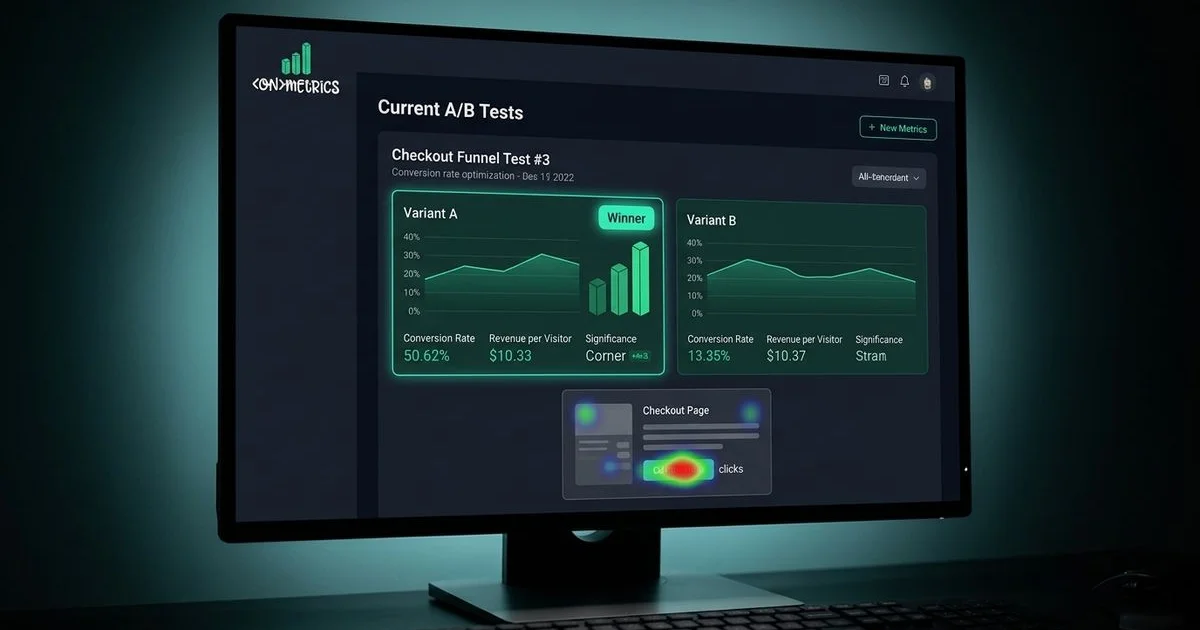
At ONmetrics, CRO is where web design, PPC, and analytics intersect. We use data from ONclix, heatmaps, session recordings, and A/B tests to systematically identify and fix the friction points that prevent visitors from converting. Every test is tracked through ONclix so you know the exact revenue impact of each change.
Why CRO Delivers the Highest ROI
Consider this: if your website gets 5,000 visitors per month and converts at 2%, that’s 100 leads. Increasing traffic by 50% (from SEO or PPC) gives you 150 leads. But improving conversion rate from 2% to 3% — with the same traffic — gives you 150 leads too, without any additional ad spend.
CRO amplifies every other marketing investment. Better landing pages mean lower cost-per-acquisition from PPC. Higher conversion rates mean more value from your SEO traffic. And with ONclix tracking, we can prove the revenue impact of every optimization.
Our CRO Process
1. Conversion Audit
We analyze your current conversion funnel using GA4, ONclix, and user behavior tools. Where are visitors dropping off? Which pages have high traffic but low conversion? Where does the journey break down?
2. User Behavior Analysis
Heatmaps show where visitors click, scroll, and hover. Session recordings reveal how real users navigate your site — where they get confused, frustrated, or distracted. This qualitative data supplements our quantitative analytics.
3. Hypothesis Development
Based on the data, we develop specific, testable hypotheses. For example: “Simplifying the contact form from 8 fields to 4 will increase form completions by 20%” or “Adding a trust badge above the CTA will increase click-through rate.”
4. A/B Testing
We implement controlled experiments where one group of visitors sees the original version and another sees the variation. Tests run until we reach statistical significance, ensuring results are real — not random.
5. Implementation and Iteration
Winning variations are implemented permanently. Losing variations teach us something valuable. We continuously iterate, running new tests based on previous learnings and new data.
6. Revenue Tracking
Every CRO win is tracked through ONclix to measure its actual revenue impact. We don’t just report on conversion rate improvements — we show you the dollars and cents those improvements generated.
What’s Included in Our CRO Services
- Comprehensive conversion audit with prioritized recommendations
- Heatmap and session recording analysis
- User experience (UX) audit
- A/B and multivariate test design and execution
- Landing page optimization for PPC campaigns
- Form optimization and simplification
- CTA placement and messaging testing
- Mobile conversion optimization
- Revenue impact tracking via ONclix
- Monthly CRO reports with test results and next steps
Common Conversion Killers We Fix
Slow Page Load Times Every second of delay reduces conversions by up to 7%. We optimize page speed to ensure visitors don’t leave before they see your content.
Confusing Navigation If visitors can’t find what they’re looking for in 3 seconds, they leave. We simplify navigation and create clear pathways to conversion.
Weak or Hidden CTAs Your call-to-action needs to be visible, compelling, and easy to complete. We test CTA copy, color, placement, and size to find what converts best.
Long, Intimidating Forms Asking for too much information too soon kills form completions. We optimize form length, field labels, and layout to reduce abandonment.
Missing Trust Signals Testimonials, reviews, credentials, and guarantees reduce purchase anxiety. We strategically place trust signals where they have the most impact.
Frequently Asked Questions About CRO
How much traffic do I need for A/B testing? Meaningful A/B tests typically require at least 1,000 visitors per variation to reach statistical significance within a reasonable timeframe. For lower-traffic sites, we focus on high-impact qualitative improvements first.
How long does it take to see CRO results? Individual test results are typically available within 2-4 weeks. However, CRO is an ongoing process — the compounding effect of multiple improvements over 3-6 months is where the real transformation happens.
Can CRO work alongside my PPC campaigns? Absolutely — CRO and PPC are natural partners. Better landing pages directly reduce your cost-per-acquisition in Google Ads. We often prioritize PPC landing pages for CRO testing because the impact is immediate and measurable.